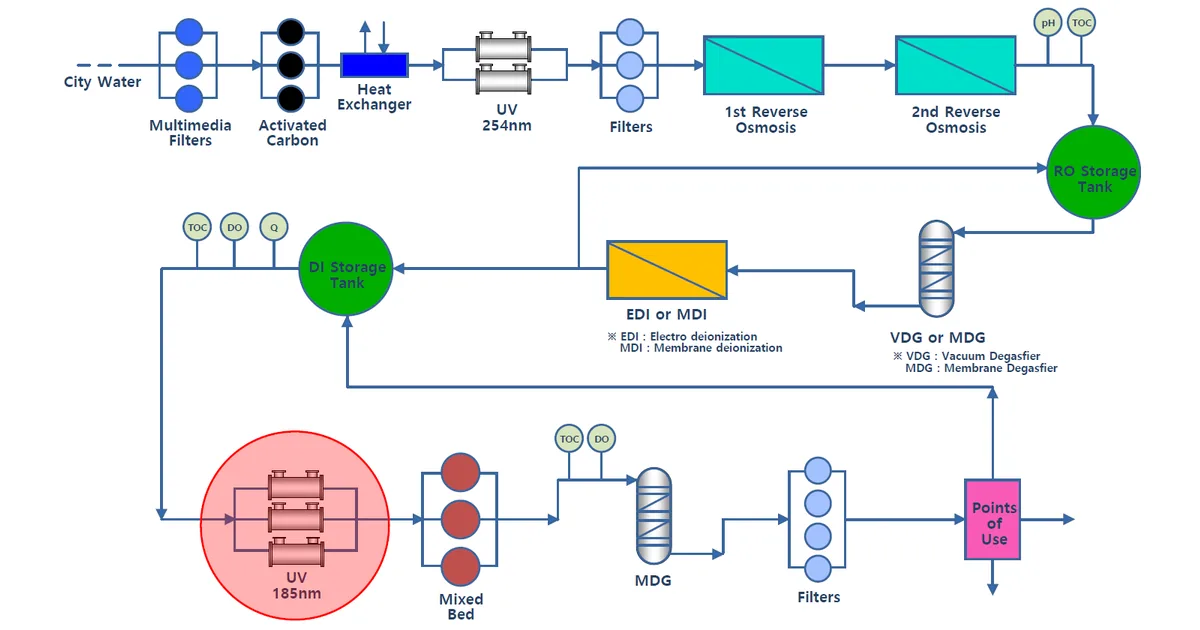
1. Purpose and background
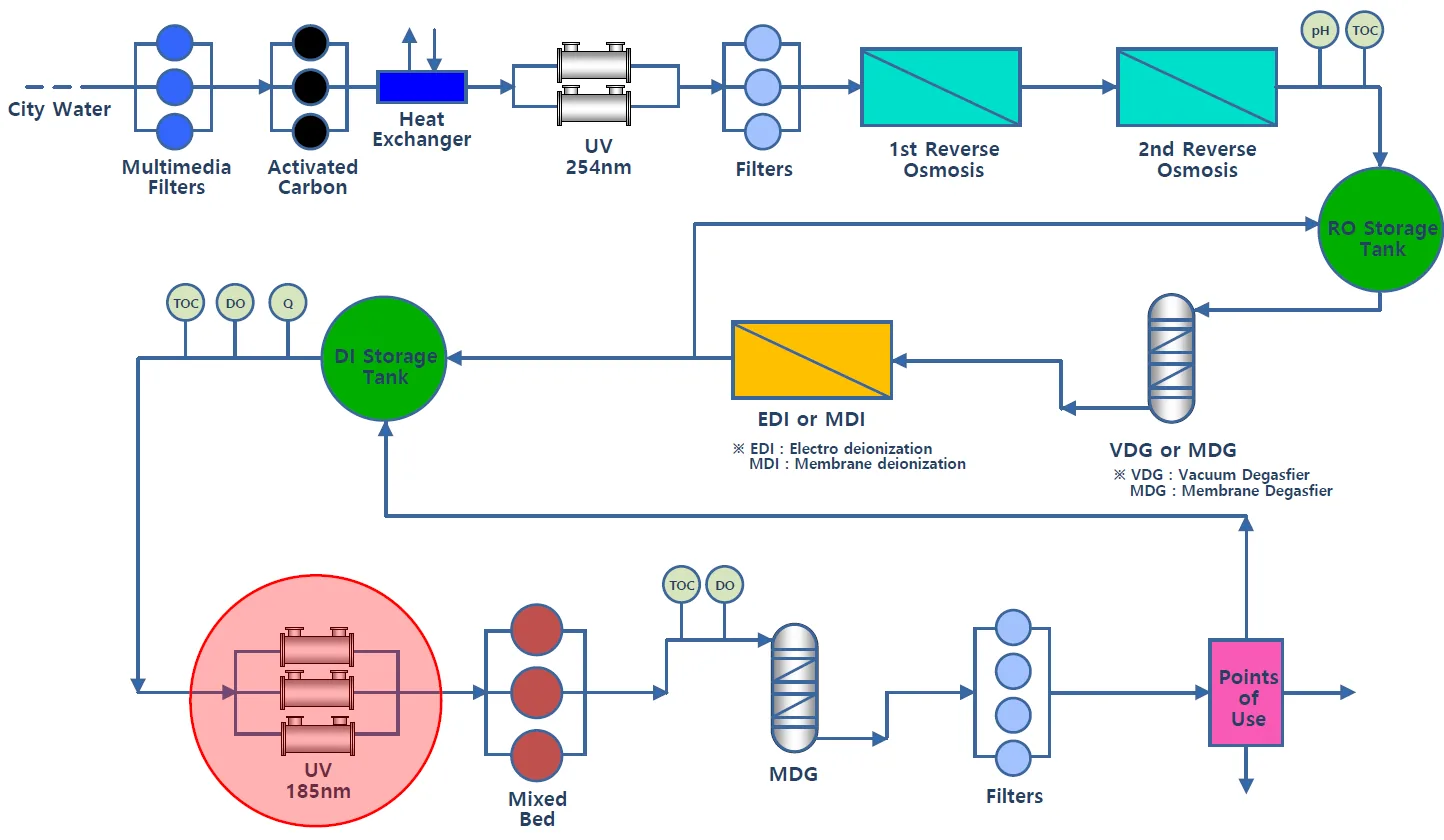
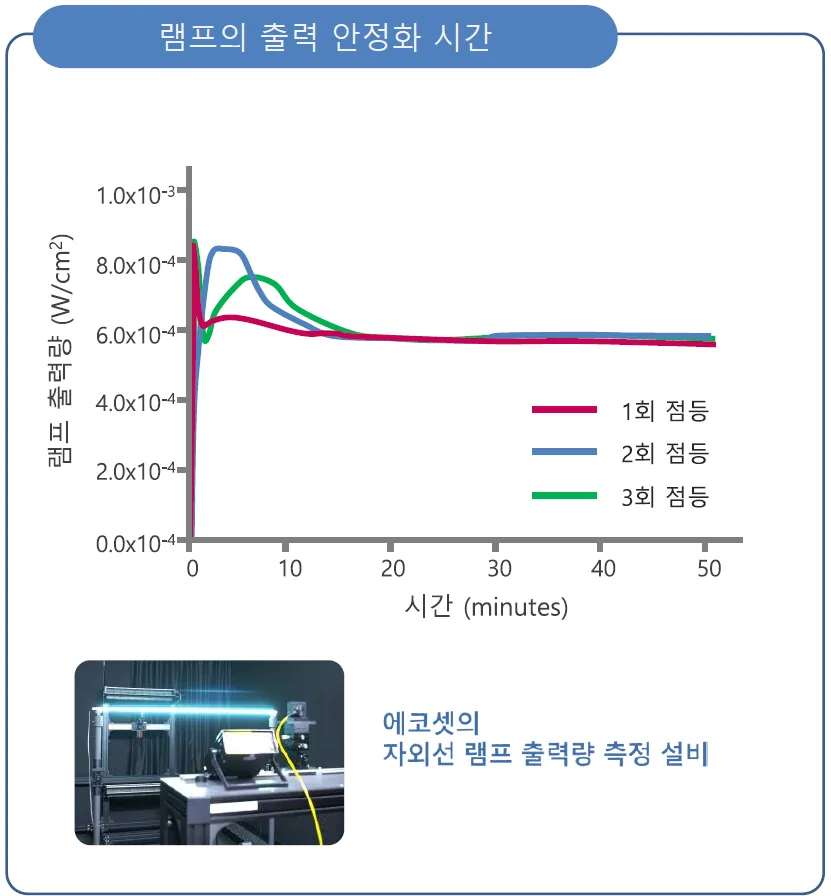
In ultrapure water (UPW) production, the UV oxidation unit is the key piece of equipment for removing total organic carbon (TOC). The conventional approach runs the lamps at fixed power and replaces them in a batch once performance has degraded and their life is over.
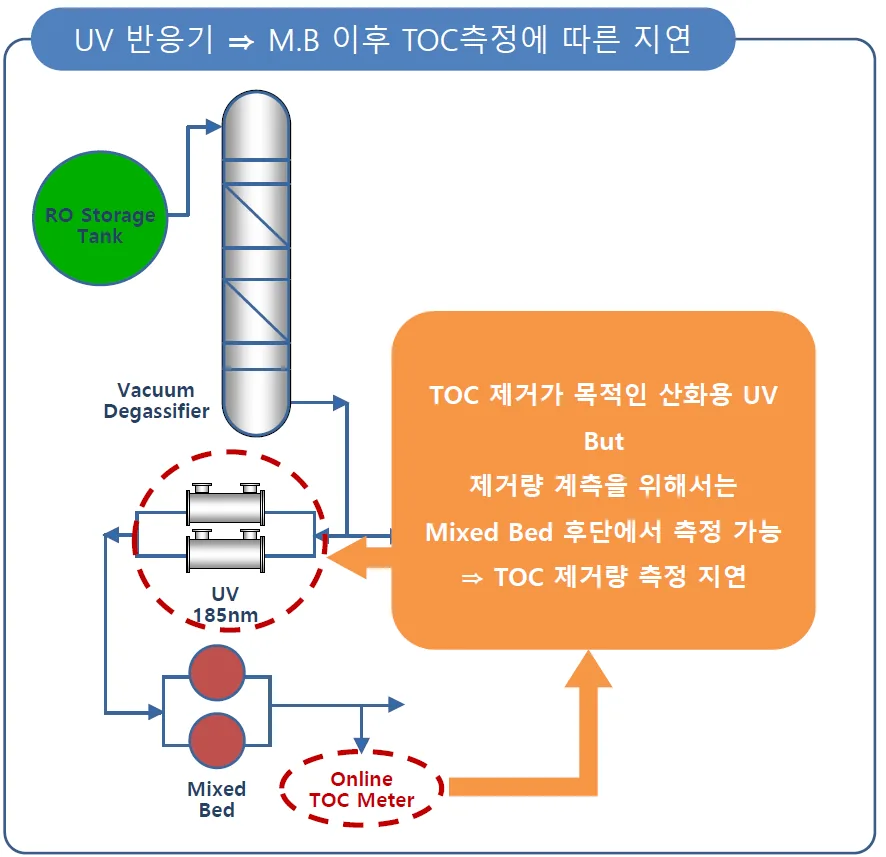
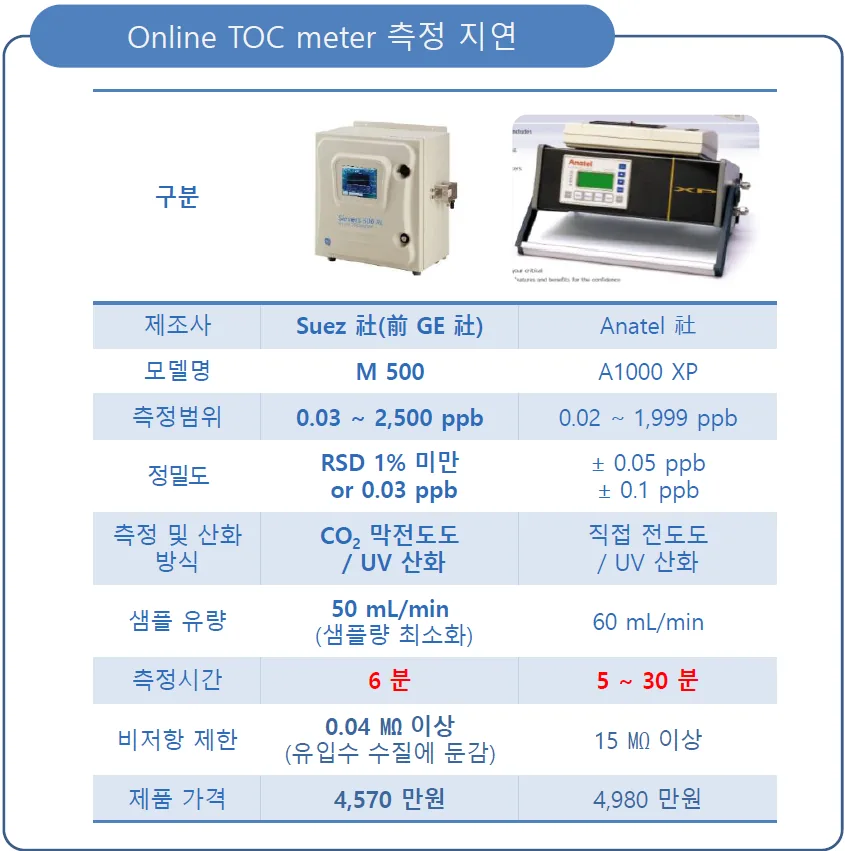
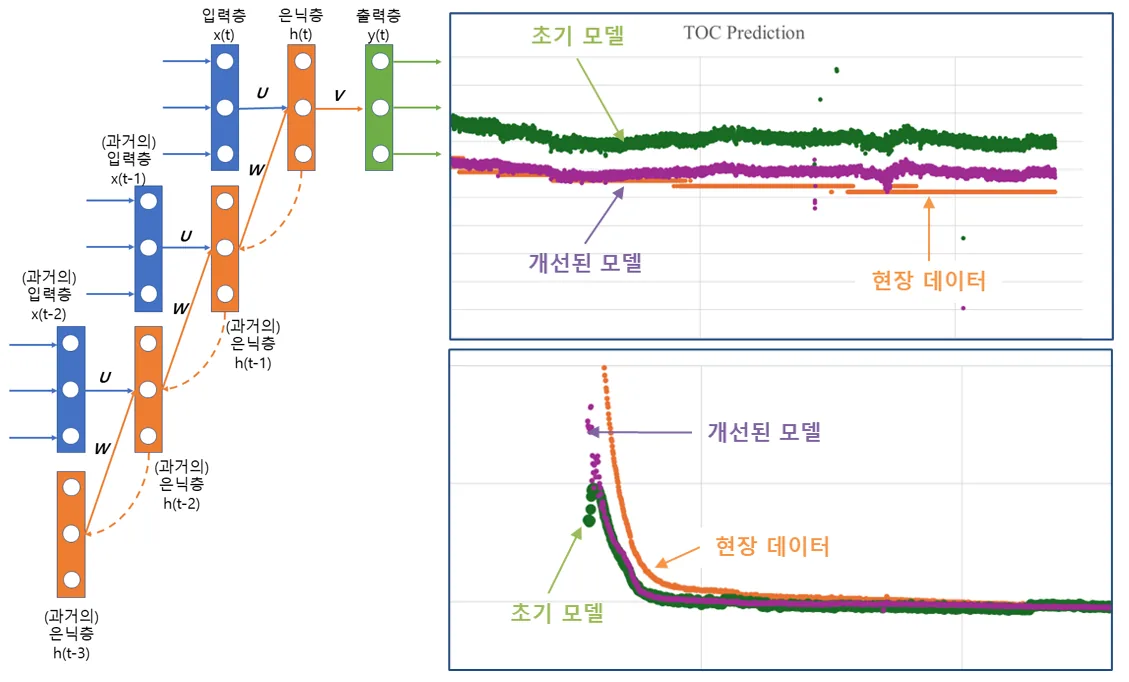
TOC measurement at the end of the process, however, typically carries a delay of 6 to 30 minutes depending on the instrument. Feedback that only responds once the reading arrives makes real-time quality control difficult, so an approach that judges the future state in advance — using physical simulation and AI prediction — is needed.
2. Limits of the conventional operating method
Fixed-power operation has three limits.
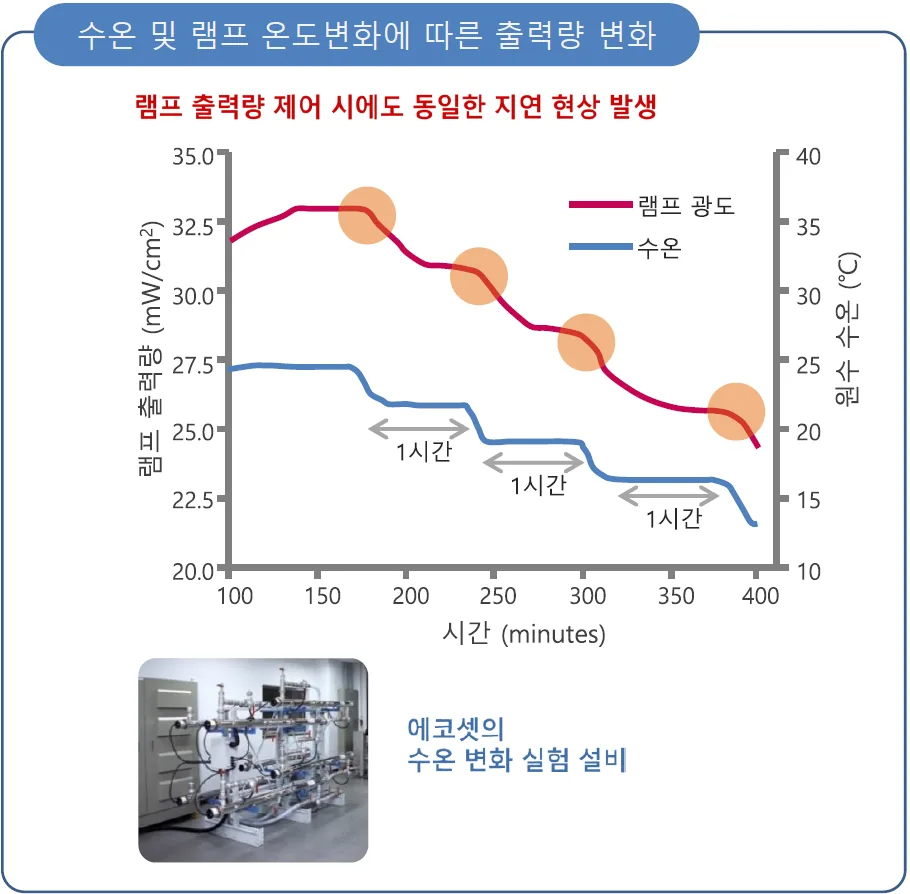
- Lamp variation and degradation — differences in optical output between lamps, and degradation over time, are hard to account for with fixed-power operation alone.
- Over-operation — using more power than necessary leads to higher energy consumption and excess dissolved oxygen (DO) generation.
- Slow fault response — when a lamp fails or its output drops, there is no immediate compensation until it is replaced.
In the field these three act at the same time, together with the process measurement delay and the light distribution inside the reactor. One fixed setting cannot handle every condition efficiently, from normal operation through to a partial lamp failure.
3. The AIoT-based control system
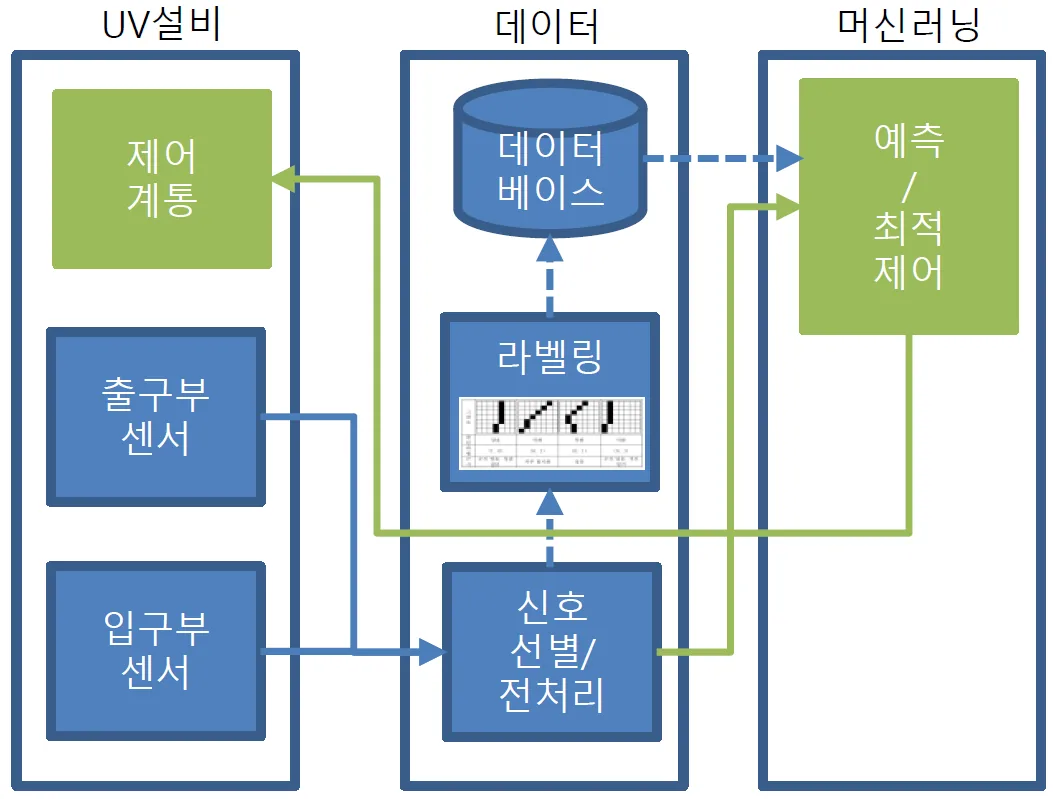
The control system is layered: sense → digital twin → edge AI prediction → control and actuation. Sensor data and the operating state of the UV unit are aggregated on an edge computer, and the control logic converts the prediction into PLC commands.
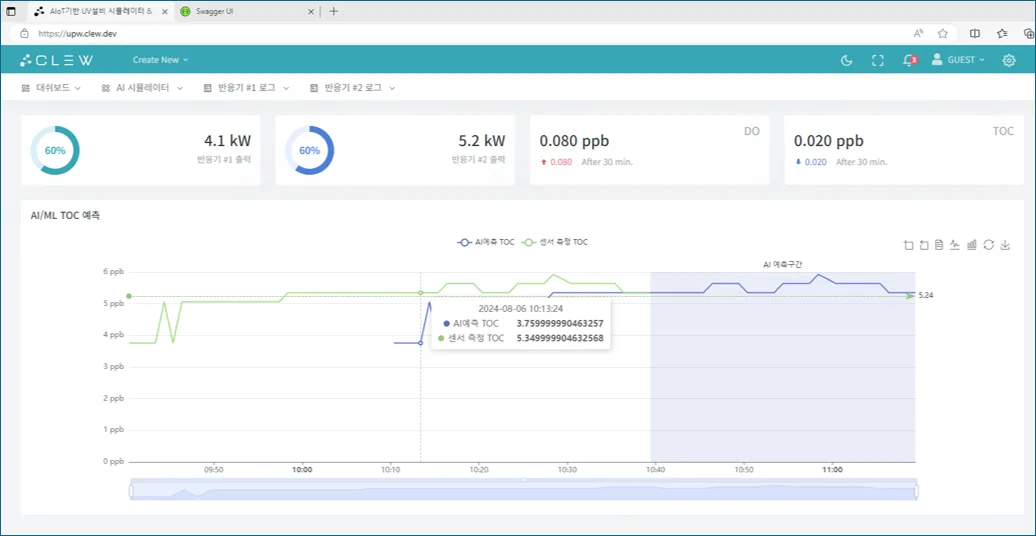
Results can be viewed on the existing HMI/SCADA or on a separate monitoring screen. The aim is not automatic control alone but a decision-support structure in which the operator can see both the basis for the prediction and the state of the equipment.
- Sense — TOC, DO, flow rate, pressure and conductivity are collected periodically, along with per-lamp power and operating state.
- Twin — information inside the reactor that sensors cannot measure directly is supplied by CFD and photochemical simulation.
- Predict (edge AI) — recent time-series data is used to predict future quality and equipment state ahead of time.
- Control — the lamp power and on/off combination that meets the quality target is computed and fed into the PLC control decision.
4. Dataset construction and the AI prediction model
Sensor data and UV operating conditions at time t are the inputs, and the TOC measured later at the end of the process is the training target. Quality items unrelated to UV oxidation are excluded from the labels to reduce confusion in the model.
- Input data — TOC, DO, flow rate, pressure and conductivity, together with the power and state of the UV unit and each lamp, as time series.
- Model structure — time-series regression models including LSTM, so that the measurement delay and the process dynamics are reflected.
- Real-time inference — a recent time window is fed in to judge whether future TOC will meet the standard if the current operation continues.
5. Lamp uncertainty and compensating operation: coupling with simulation
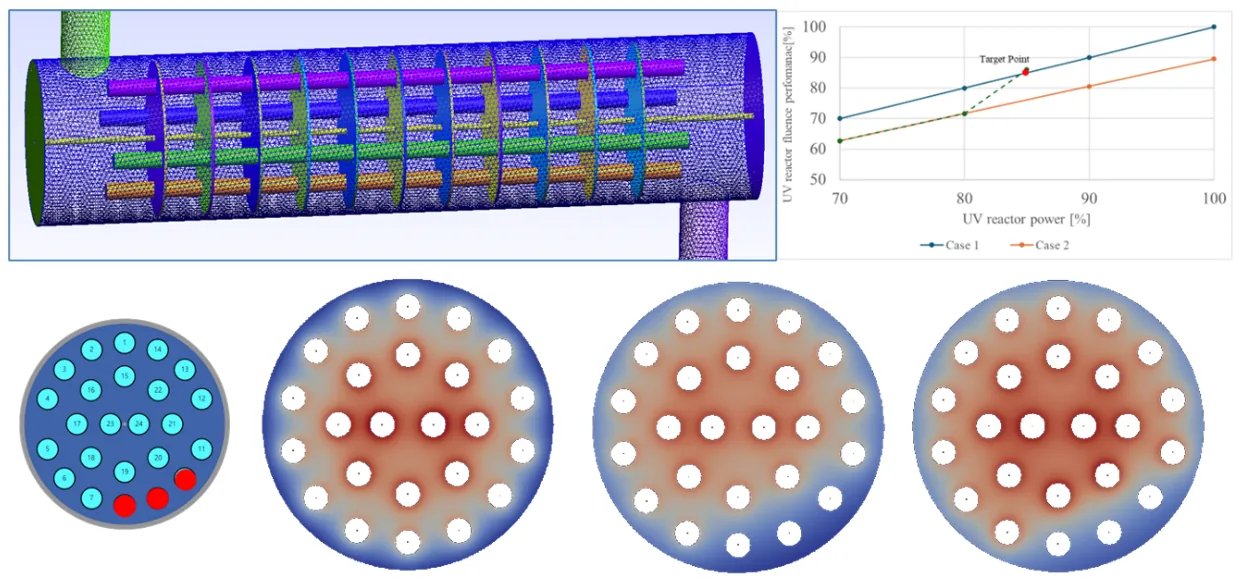
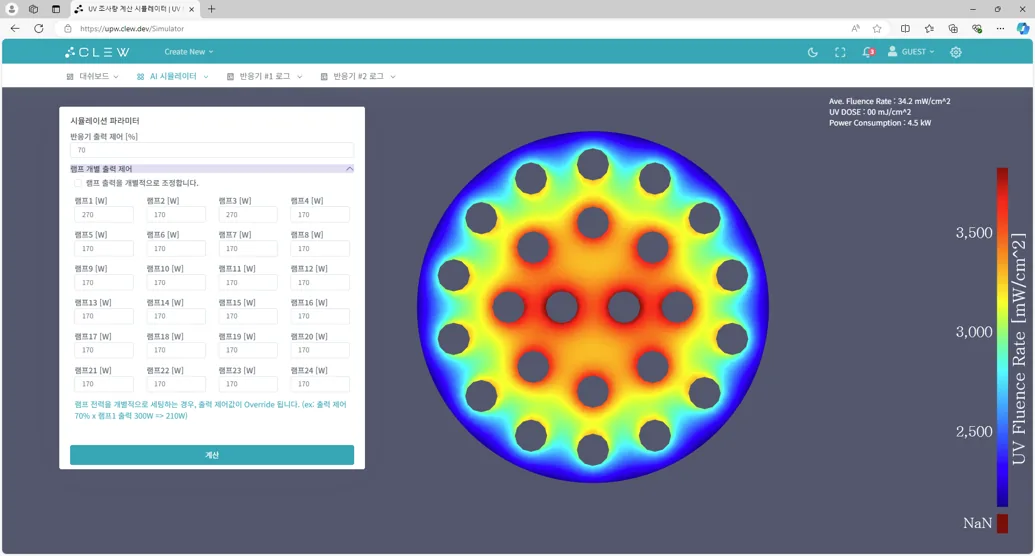
Lamp irradiance inside the UV oxidation unit is hard to sense directly; the PLC generally sees only the input power and state of each lamp. To handle manufacturing variation, degradation and intermittent shutdown, reactor modelling is coupled with irradiance distribution simulation.
Assuming a particular lamp has gone out or degraded, the search then covers combinations of power increments on the surrounding lamps. A setting that meets the target reaction (TOC removal) is passed to the PLC and used for compensating operation, reducing the temporary effect on water quality that would otherwise occur before replacement.
6. Expected benefits
This research aims to treat quality stability, operating cost and fault tolerance within a single control objective.
Simulation during the research identified a potential saving of over 30% in operating cost for a semiconductor-grade ultrapure water process. This figure is a simulation-based estimate, and the actual benefit depends on the equipment configuration and operating conditions.
- Quality stability — AI prediction compensates for the measurement delay, allowing pre-emptive response to the risk of a TOC excursion.
- Operating cost — avoiding unnecessary fixed 100% operation reduces power consumption and lamp replacement cost.
- Fault tolerance — when a lamp goes out or performance varies, simulation-based compensating operation reduces the shock to water quality.
- Operational competitiveness — an efficient operating model in which the balance between energy, quality and lamp life is judged from data.

Acknowledgements
This work was supported by Korea Environment Industry & Technology Institute (KEITI) through the High Purity Industrial Water Domestic Production Technology Development Project, funded by the Korea Ministry of Environment (MOE) (20210032002).
This technology is part of the results of a collaborative research and development project carried out with Ecoset Co., Ltd., a water treatment specialist.